English (UK)
  Português
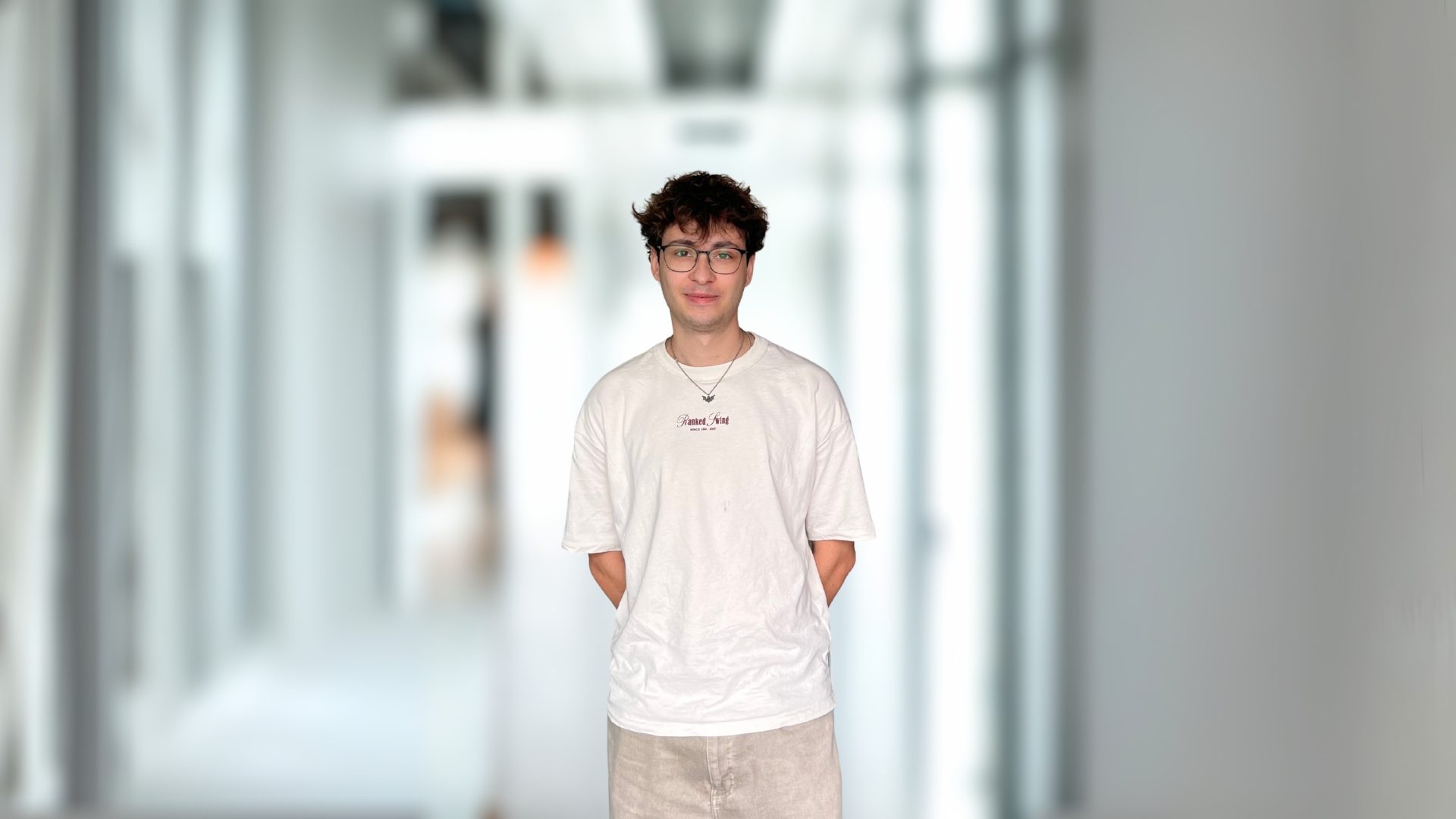
During the summer, Tiago Pedrosa joined Exatronic’s Design & Development team with a very clear goal: to turn his curiosity about firmware into hands-on experience.
More than simply learning concepts, he wanted to understand what happens when theory leaves the classroom and enters a real engineering environment: working directly with hardware, testing different approaches, solving problems and seeing what we develop actually start to work.
There was also a more personal question he wanted to answer: was firmware simply an area that sparked his curiosity, or could it become something he would want to pursue in the future?
We spoke with Tiago about the challenges he faced, what he learned and what it really means to bring hardware to life through firmware.
What led you to look for an experience at Exatronic over the summer and, more specifically, to explore firmware?
Throughout my academic journey, I felt there was a strong theoretical component, and I was missing the opportunity to take that knowledge and understand how it applied to a real-world challenge.
I had worked on a few personal projects, but I wanted to go further.I wanted to work in a professional environment where what we develop has a clear purpose and where problems do not always come with a predefined solution.
Firmware was already an area I was very curious about. I joined this experience precisely because I wanted to test that interest in practice and understand whether it was something I wanted to pursue more seriously in the future.
When you joined the Design & Development team, where did you start?
Starting from a specific project, I began by thinking about the architecture and how the different hardware blocks should be organised so they could work together coherently.
I quickly realised that, before starting to program, I first needed to fully understand what I was building: the role of each block, how it related to the others and how everything could later be integrated.
Having that overall view from the beginning gave me a much stronger foundation to move forward. In the following stages, I was no longer simply developing isolated parts, I understood where each one fitted and why.
Part of your work involved “bringing those hardware blocks to life” through firmware. How would you explain firmware to someone outside the field?
I would compare firmware to the brain of a living being. We can have eyes, legs or arms, but each of those parts needs to know what to do, when to do it and how to work together with the others.
Something similar happens with hardware. First, you need to understand how each component works. Then, through firmware, we create the logic that allows it to perform the function it was designed for and communicate with the other components.
That is the part I find particularly interesting: taking hardware that, on its own, is simply a collection of components and making it start to respond, communicate and operate as a system.
What technical challenge taught you the most during this experience?
One of the challenges that made me think the most was implementing an RFID reader. There are several options available on the market and, although they may look similar at first, each one has different characteristics and ways of working. I had to explore those alternatives, understand the differences and identify the most suitable approach.
But the most memorable moment came when I managed to get several modules working simultaneously and, above all, interacting with one another. Until then, I had been very focused on getting each individual part to work. When I saw everything communicating for the first time, I really started to see the system as a whole.
That was probably the moment when I thought: now it is really starting to come to life.
What was it like being part of an engineering team where you could discuss questions and test different approaches?
It made a huge difference. When you are learning on your own, you can spend a lot of time stuck on a problem without even knowing whether you are heading in the right direction. Here, whenever a question came up, I had people around me who had often dealt with similar problems before and could help guide me.
That did not mean simply being given the answer. Often, it meant understanding where to look, which hypothesis made the most sense to test, or finding a different way to approach the problem.
Working every day with more experienced people who genuinely enjoy what they do and have knowledge to share made the learning experience much richer.
You joined Exatronic with some doubts about whether firmware could be part of your future. What about now?
That was probably the biggest question I wanted to answer when I started.
I was interested in firmware, but I did not yet know whether that interest came mainly from curiosity and a lack of practical experience, or whether it was genuinely an area where I could see myself working.
Today, I have a much clearer answer.
I realised that I enjoy the process: researching, testing, understanding why something is not working, fixing it and eventually reaching the point where it does. I want to continue exploring firmware, take some of what I have learned into my undergraduate project and, once I finish my degree, it is definitely one of the areas I want to consider as I begin my professional career.
Not every first professional experience is about confirming a path. Sometimes, it is precisely about putting that path to the test.
Tiago joined Exatronic with curiosity, a desire to put theory into practice and a question about what he might want to do in the future. Over the summer, he had the space to experiment, fail, adjust, ask questions and watch what he was developing begin to work.
In the end, he took away more than new technical skills. He found a direction. And perhaps that is one of the most valuable outcomes of an experience like this: not just learning how things are done, but discovering what we want to keep doing.