English (UK)
  Português

From Risk to Resilience: Why 2026 Is the Year of Intelligence in Portuguese Electronics
A Realidade do Passado: O Ano da Adaptação
If we look at Portugal’s industrial landscape in recent years, the watchword has been prudunce. Companies in the electronics manufacturing services (EMS) sector faced a dual scenario: on the one hand, a slow recovery of supply chains following the semiconductor crisis, within an uncertain geopolitical context; on the other, increasing difficulty in recruiting specialised technicians for high-precision roles.
In the past, many Portuguese factories operated at the limits of manual optimisation. Digitalisation was seen as a medium-term objective, largely focused on administrative management. However, the global market did not wait. Demand for smaller devices, where mass customisation became the norm, combined with ever stricter quality certifications, placed unprecedented pressure on national assembly lines.
The Turning Point: The Awakening of 2026
We entered 2026 with one certainty: human intuition and traditional mechanical processes are no longer sufficient to ensure competitiveness. The turning point we are witnessing at the start of this year is not merely technological—it is strategic. Record investment in R&D by national companies in recent years has laid the groundwork for this transition.
What separates the electronics industry of the past from the reality of 2026 is the shift from “Passive Automation” to “Active Intelligence“.
- In the past, machines were limited to executing instructions.
- In 2026, machines begin to interpret data, predict failures and self-adjust.
This leap is driven by two critical factors in the Portuguese context: the need to reduce waste (in an economy increasingly circular and conscious of energy costs) and the urgency to elevate “Made in Portugal” to zero-defect standards, competing directly with European giants through technical sophistication rather than price.
In this article, we are not talking about science fiction. We analyse how AI and next-generation automation are, today, everyday working tools at Exatronic, enabling us to respond to the demands of a market that no longer accepts anything less than perfection.
Precision Engineering: Where AI Meets the Factory Floor
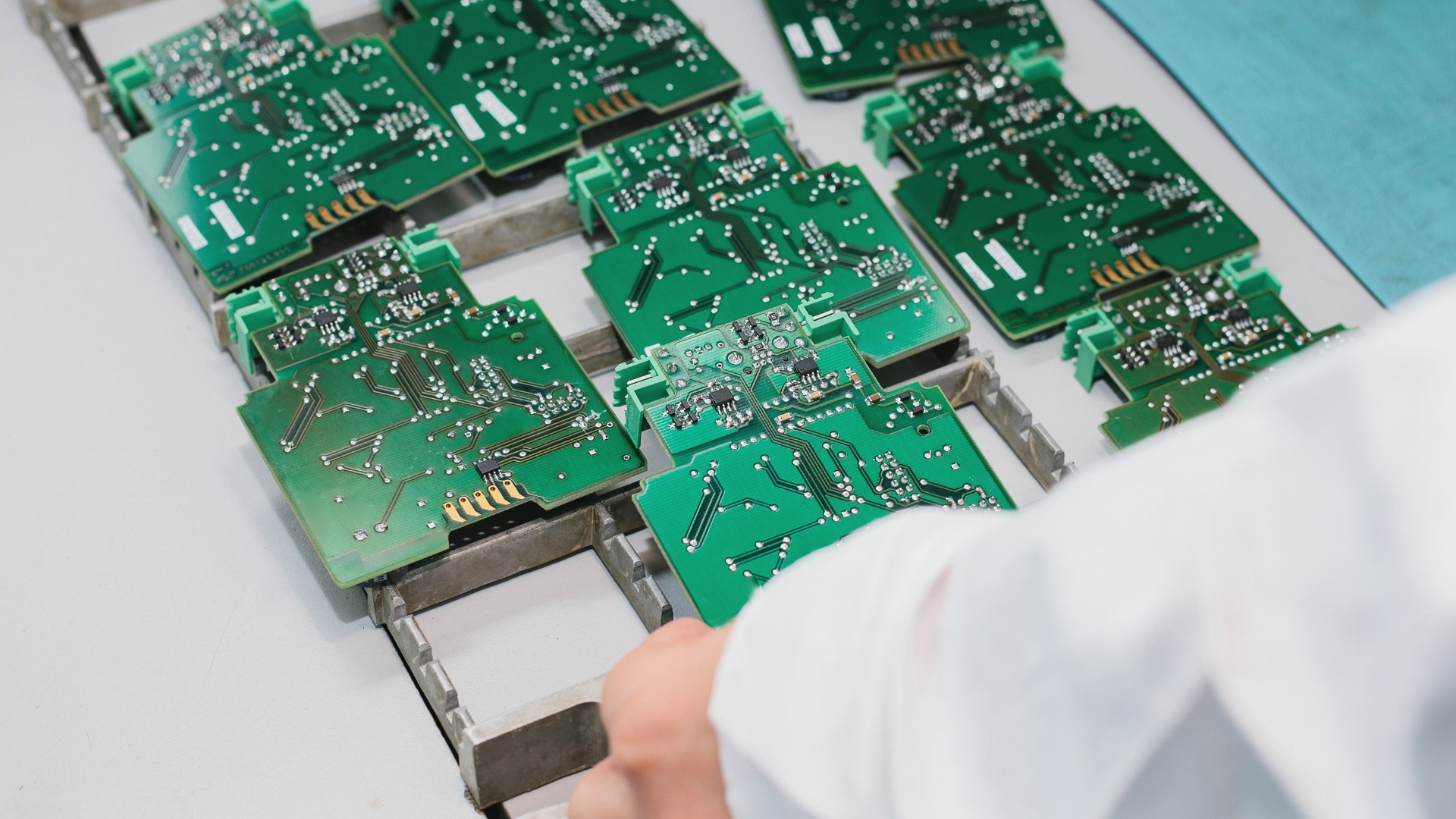
This transition to Active Intelligence manifests itself in three fundamental pillars which, at Exatronic, we see as a single integrated mechanism.
01.
From Inspection to Learning: The New AOI Standard
The first line of defence against error is Automated Optical Inspection (AOI). If in the past the challenge was to reduce “false negatives” that overburden technicians, in 2026 the solution lies in Deep Learning applied to computer vision.
Systems based on convolutional neural networks now not only detect defects but also learn acceptable variations in increasingly miniaturised components, such as 01005 packages. This evolution allows inspection to move beyond being a passive filter and become a data sensor that informs the entire line about quality drifts in real time.
02.
Predictive Maintenance: The Pulse of Production
Once inspection quality is assured, the focus shifts to continuity. Full connectivity of SMT assembly machines now allows us to implement predictive maintenance with unprecedented accuracy.
Through vibration and thermal analysis via IoT sensors, the system anticipates failures before they cause line stoppages. AI-driven maintenance can reduce unplanned downtime by up to 45%. For Exatronic’s customers, this translates into operational resilience that protects delivery schedules against technical disruptions.
03.
Edge AI: Intelligence at the Moment of Action
At the top of this efficiency pyramid is Edge AI. While predictive maintenance looks to the future, Edge AI acts in the absolute present. In 2026, component placement machines process data locally, without reliance on the cloud, enabling microsecond-level adjustments in positioning or placement pressure.
This real-time self-adjustment capability ensures process stability in the face of minimal variations in materials or the factory environment. This is where the “Intelligent Value Chain” is completed: the machine does not merely execute—it corrects itself to maintain the standard defined by initial inspection.
Sustainability as a By-Product of Digital Precision
In 2026, sustainability in the PCBA industry has shifted from being an ethical directive to becoming a metric of operational efficiency. At Exatronic, we understand that every assembly error avoided is one less set of components ending up as electronic waste. Intelligence applied to the factory floor is now our most powerful environmental tool.
Resource Optimisation and “Zero Waste”
The integration of AI into stencil printing and solder paste application enables such precise volumetric control that waste of metallic alloys has been reduced to the technical minimum. By avoiding rework through early detection via AOI, we eliminate the duplicated energy consumption that would otherwise be required to correct a defective board. AI-driven industrial process optimisation can reduce the carbon footprint of semiconductor and EMS factories by up to 20%.
Dynamic Energy Efficiency in Reflow Ovens
One of the highest energy consumption points on an assembly line is the reflow oven. In 2026, we are implementing Digital Twin algorithms to Digital Twin to simulate the ideal thermal profile for each board before the machines are even switched on. This allows the oven to operate with dynamic temperatures, consuming only the energy strictly necessary to ensure perfect soldering, in line with the efficiency guidelines of the EU Ecodesign Directive.
Durability: The Impact of “Right-First-Time”
The most effective sustainability strategy is ensuring that a product does not fail prematurely. By using predictive maintenance and intelligent inspection, we guarantee absolute structural integrity of the electronic board. This care, combined with correct handling of PCBs throughout the manufacturing process, extends the lifecycle of devices in the market, combating technological obsolescence and aligning Exatronic’s production with European goals for Strategic Autonomy and a Circular Economy.

Leading Change, Securing Trust
The landscape we outline for 2026 is not a distant scenario; it is the operational reality that defines who grows and who stagnates in the global market. The transition from electronics based purely on production capacity to electronics driven by data intelligence is the greatest qualitative leap of the past decade.
We understand that the adoption of AI, predictive maintenance and eco-design processes are not end goals, but means to achieve what our partners value most: predictability. In a world where market variables change daily, having the assurance that your hardware will be produced with zero defects, on time, and under the strictest sustainability standards is the greatest competitive advantage we can offer.
The technology available in 2026 gives us the tools, but it is the commitment of our team and the strength of our vision that make them effective. We are not merely assembling components onto boards; we are enabling the technological solutions that will shape tomorrow.
The Heart of the Future: Natural Intelligence
Natural intelligence is the most abundant resource — and also the most decisive. True transformation is driven by attentive people: professionals capable of questioning data, interpreting contexts that algorithms cannot capture, and making decisions that go beyond mere technical optimisation. Attentive and highly skilled people are therefore the critical success factor on our journey.
In 2026, our true asset is neither software nor hardware. It is the quality of the people who have chosen to be here and to build this path with us. Because without natural intelligence guiding artificial intelligence, no machine can guarantee results. It is people who make all of this possible.